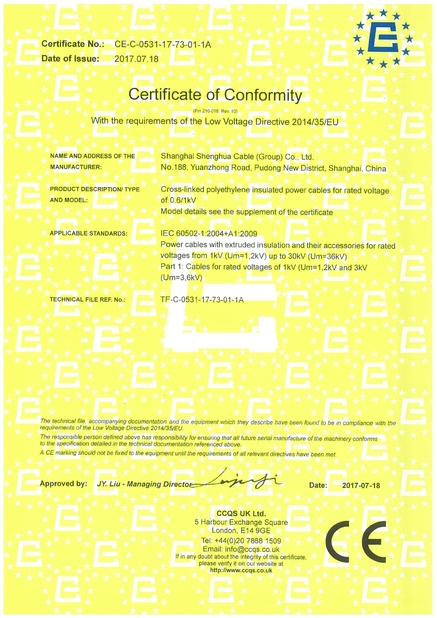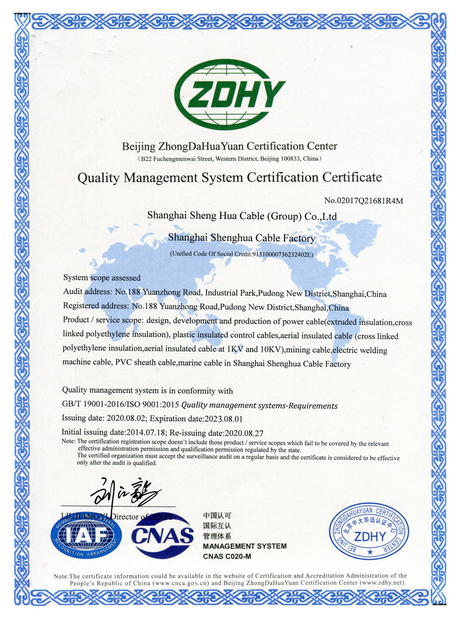
Shanghai Shenghua Cable (Group) Co., Ltd.
A screen is the copper or aluminium layer that surrounds the insulation or the core assembly of a cable, and it exists to control electric field, contain electromagnetic interference or provide a low impedance return path. In PVC insulated low voltage cable, screening is often optional; in variable speed drive systems, instrumentation and medium voltage work, it is essential. This guide explains what a screen does, the difference between a tape screen, a braid screen and a combined screen, how the screen must be earthed to work, and what happens when it is not. Six answers follow on earthing practice, transfer impedance, screening effectiveness and specification.

In a medium or high voltage cable, the screen controls the electric field within the insulation. Without a conductive layer at the surface of the insulation, the field concentrates at voids and at the interface, and partial discharge begins, which erodes the insulation until it fails. The screen equalises the field, so the insulation is stressed uniformly.
In a low voltage cable, the screen performs a different role. It contains the electromagnetic field generated by current in the conductors, reducing the interference radiated to nearby signal cables. It also provides a return path for high frequency currents, which is important in variable speed drive applications where the motor cable carries switching transients with fast edges.
In instrumentation and control cable, the screen protects the signal from external interference. A signal of a few millivolts is easily corrupted by the field from a nearby power cable, and a screen with a proper drain connection keeps the signal clean.
The screen material matters. Copper tape gives high coverage at low cost but is less flexible. Copper braid gives flexibility and good coverage but costs more. Aluminium foil with a drain wire is cheap and effective at high frequencies but fragile at terminations. Combinations, such as aluminium tape plus copper braid, are common where both high frequency performance and mechanical robustness are required.
A screen that is not earthed is an antenna. It will pick up interference and, worse, it can capacitively couple that interference into the conductors it was meant to protect. The screen only works when it is connected to a reference potential at the correct points.
For medium voltage cables, the metallic screen is earthed at both ends, because it is part of the field control system, and the circulating currents that result are accepted or managed through the bonding design. For low voltage power cables in drive systems, the screen is normally earthed at both ends, using a 360 degree termination rather than a pigtail, because a pigtail destroys the high frequency performance.
For instrumentation cables, the usual practice is to earth the screen at one end to avoid ground loop currents, unless the system design requires both ends. This is a design decision, and getting it wrong produces either noise or circulating current, both of which are hard to diagnose after commissioning.
The termination of the screen is as important as the screen itself. A braid clamped over the full circumference with a metal gland or a conductive clamp gives a low impedance connection across the frequency range. A single wire soldered to the braid and taken to a terminal provides a high impedance path at high frequency, which is exactly where the interference lives.
The first reason is compliance. Many drive and instrumentation installations specify screened cable in the design, and a substitute without a screen will fail commissioning because the electromagnetic compatibility requirements are not met.
The second reason is fault diagnosis cost. Interference problems appear as intermittent faults, spurious trips and corrupted readings, and finding them after the plant is running is expensive. A screened cable installed correctly prevents the problem for a small cost premium.
The third reason is safety in medium voltage work. A cable without proper field control will fail through partial discharge, and the failure may be violent. The screen is a safety component, not an accessory.
The fourth reason is specification clarity. A buyer who states the screen type, the coverage and the earthing arrangement gets a cable that works. One who states screened without detail may receive a foil wrap with a thin drain wire that performs poorly in the intended application.
State the purpose: field control, interference containment, or signal protection. Each leads to a different construction. Then state the screen type and the minimum coverage, for example copper tape with overlap, or copper braid with at least 85 percent coverage.
State the earthing requirement and the termination method. If the screen must be earthed at both ends with a 360 degree gland, say so, because that determines the gland type and the installation instruction. Where one end earthing is needed, state which end.
Ask for the transfer impedance or screening attenuation data if the application is critical. These values describe how well the screen performs at high frequency, and a supplier who can provide them is a supplier who understands screening rather than merely offering it.
Specify the drain wire where a foil screen is used, and confirm its size and connection method. A drain wire that is too small or poorly connected is a common weak point, and it is invisible after installation.
Finally, confirm the accessory compatibility. Screened cable needs screened glands, and the gland must match the cable diameter and the screen type. Products such as the Shanghai Shenghua Power Cable Professional Control Flexible Wire Cable Eco Friendly CE KEMA Certification and the PUR Jacket Waterproof Drag Chain Cable 4x1.5mm2 300/500V Tinned Copper Shielded Flexible Cable show how screened constructions are described, and the screen is usually stated as a separate line in the specification rather than implied by the type code.
A drive system generates a pulse width modulated output with very fast switching edges, and the motor cable carries a common mode current that will find a return path wherever it can. Without a proper screen, that current flows through the earth conductor, the building structure and any signal cable in the vicinity, producing interference, bearing currents and nuisance trips.
The correct construction is a symmetrical three core cable with a copper braid screen and a separate earth conductor arranged symmetrically, terminated with an EMC gland that clamps the braid through 360 degrees at both ends. The screen carries the common mode current back to the drive, where it belongs, and the interference problem disappears before it starts.
The common error is to terminate the screen with a short pigtail at one end only. This presents a high impedance at the switching frequencies that matter, so the screen does little, and the installation behaves as though it were unscreened. The error is invisible in a visual inspection and expensive to correct after commissioning.
A screen adds capacitance between the conductors and the earth reference, and on long runs the charging current becomes significant. In a drive system this is part of the design and is accounted for in the cable selection. In a long instrumentation run, the added capacitance can affect signal rise times, and the cable length must be limited or the screen design adjusted.
Screened cable is also stiffer and heavier than unscreened, which affects pulling and support. Tray spacing may need to be closer, and the minimum bending radius is larger. These practical consequences are worth stating at the quotation stage, because a site that planned for unscreened cable may need different supports.
The screen also has a thermal effect. In a cable with a metallic screen, heat from the conductors passes through the screen to the sheath, and the rating may be slightly lower than for an unscreened equivalent. Manufacturers state the rating for the screened construction, and the designer should use that value rather than the unscreened table.
A screen is only effective if it is continuous along the route and properly connected at the ends. During installation, the screen can be damaged by a sharp bend or by a pulling grip that crushes the cable, and the damage may not be visible. A continuity test on the screen, recorded with the installation, gives a baseline for later comparison.
Over time, the connections at glands and joints can corrode, particularly outdoors or in wet locations. A periodic inspection of the screen bonding at accessible points is a cheap preventive measure, and it is often neglected because the circuit continues to work while the screen performance degrades silently.
Where a screen is earthed at one end, the unbonded end carries a voltage during fault conditions, and it must be insulated or protected. This is a safety point that is sometimes missed in instrumentation installations, where the screen is treated as a signal conductor rather than as a metallic part of the electrical system.
Five points decide whether a screen will perform: the purpose, the screen type, the coverage, the earthing arrangement and the termination hardware. Each is quick to state and each has caused a commissioning problem when omitted.
Where the application involves drives or instrumentation, ask for transfer impedance or attenuation data, and keep the test report with the delivery documents.
Screened cable should be pulled with a grip that does not compress the screen, and the screen should be inspected at each end before termination. Where the cable passes through a metal bulkhead, bond the screen at the entry point to maintain the reference. These details take minutes and determine whether the screening works in service.
No. A screen controls electric field and interference; an armour provides mechanical protection. Some cables have both, and they serve different purposes.
For medium voltage and drive cables, usually yes. For instrumentation, often one end to avoid ground loops. The design should state which.
A measure of how well a screen contains high frequency currents. Lower transfer impedance means better screening performance.
For high frequency containment it can be effective, but the foil is fragile and needs a proper drain connection. Braid is more robust mechanically.
It adds material and process cost, typically a few percent for a tape screen and more for a braid. The saving from avoiding interference problems is usually larger.
An EMC gland that clamps the screen over its full circumference. A standard gland with a pigtail connection defeats much of the screening.
A screen works only when it is the right type, correctly specified and properly earthed at the correct points. State the purpose, the screen type, the coverage and the earthing arrangement, and use accessories that maintain the connection over the full circumference. Shanghai Shenghua Cable Group supplies screened PVC insulated power, control and instrumentation cable with copper tape, braid and combined screens, together with the screening data and compatible glands for the installation. Send your application details through our contact page and our engineers will confirm the construction. Related items include the KVVP 4x1.5mm2 Shielded Flexible Oxygen-Free Copper PVC Insulated Control Cable 450/750V, the Copper Jacket Control Cables With Class2 Connector And CE Voltage Rating, the CE Rated Indoor Control Cables Male / Female Connector For Industrial Applications, the High Voltage XLPE Stranded Conductor Cable Three Core Screened KEMA / CE, the Shanghai Shenghua Group Cable Unarmoured PVC Control Cables Non-Screened For Indoors / Cable Trench and the Shanghai Shenghua Group Cable CU / Mica Tape Fire Resistant Cable For Sprinkler / Smoke Control System.
Inspection at the ends before termination takes a minute and prevents the most common screening failure.
Bonding at metal penetrations maintains the reference that the screen depends on.