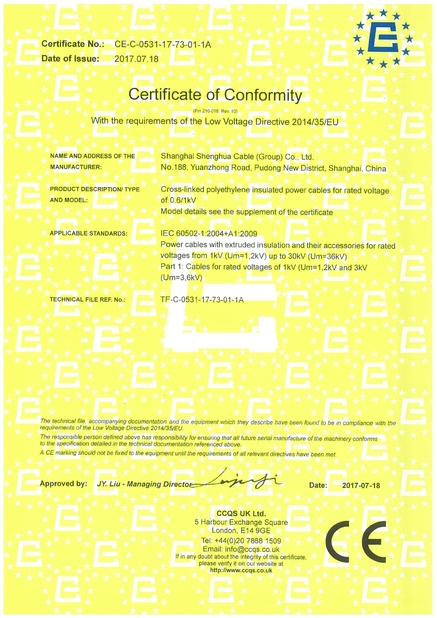
Shanghai Shenghua Cable (Group) Co., Ltd.
Sheath colour looks like a cosmetic choice until a project inspector rejects a drum on site because it is black when the specification calls for grey, or because two circuits of the same size cannot be distinguished in a tray. Colour is a documented requirement in many public and industrial specifications, it carries meaning in some installation codes, and it is one of the cheapest differentiation tools a buyer has. This guide explains what sheath colour does and does not control, why standards restrict some colours, how colour is achieved in PVC compound and what can go wrong, and how to specify and verify it. Six answers follow on colour meaning, custom shades, minimum quantities and ultraviolet exposure.

The sheath is the outer protection of the cable, and its colour is a surface property of the PVC compound. It does not change electrical performance, conductor size or insulation thickness. What it changes is identification, appearance, and in some markets, compliance.
In many specifications black is the default for power cable, because carbon black is an effective and inexpensive ultraviolet stabiliser. Grey is common in European installation practice for certain cable families, and orange is used in some markets for particular duty such as temporary or industrial supply. In industrial plants, colour is often used to distinguish voltage levels or systems: one colour for normal supply, another for emergency or uninterruptible supply, another for direct current. In those plants the colour code is part of the electrical safety documentation, and a wrong colour is a documentation failure, not an aesthetic one.
Some colours are restricted. In the IEC system the green and yellow combination is reserved for protective conductors, which is why it appears on earth wire and on the sheath of some earthing cables, and why it must not be used decoratively. Red is reserved in some national codes for specific functions. A supplier who offers any colour on request without checking the destination market may deliver a cable that cannot be used.
The colour is produced by pigment or masterbatch in the PVC compound. Carbon black gives black and improves weathering resistance. Titanium dioxide and other pigments give light colours but can reduce weathering performance unless the formulation is adjusted. Cheap pigment loading produces streaky or fading surfaces, which is a quality signal even when the electrical properties are correct.
| Colour | Typical use | Notes |
|---|---|---|
| Black | General power cable, outdoor | Carbon black gives UV resistance |
| Grey | European installation practice | Common in fixed wiring |
| Orange | Industrial or temporary supply | Market-specific meaning |
| Red | Fire alarm or emergency circuits | Code dependent |
| Green/yellow | Protective conductor only | Reserved, never decorative |
| Blue | Neutral identification in some systems | Confirm local code |
The first cause is a specification that names a colour without a reference. Grey covers a wide range from light to charcoal, and a buyer expecting a light grey who receives a dark one has a legitimate complaint that the supplier did not anticipate. Where colour matters, provide a physical sample or a colour reference rather than a word.
The second cause is minimum quantity. Extrusion lines run continuously, and a custom colour requires cleaning the line and running a batch. Small orders in a non-standard colour therefore carry a setup cost or a minimum length, and a buyer who expects custom colour at standard price will be surprised. Planning colour choices across several items in one order reduces the penalty.
The third cause is ultraviolet exposure. A light coloured sheath without adequate stabilisation will chalk and fade in sunlight within a couple of years, and in a hot climate the surface can crack. Black cable with proper carbon black loading is the safe default outdoors; a light colour outdoors needs a compound formulated for it, not just a pigment change.
The fourth cause is confusion between sheath colour and core colour. The sheath identifies the cable; the cores inside identify the conductors. Specifiers occasionally ask for a sheath colour intending a core identification, or vice versa, and the resulting order is wrong in a way that only becomes obvious when the drum is opened.
The fifth cause is mismatch between drum labels and product. A factory that runs several colours in a week can mislabel a drum, so the print on the sheath and the label must be checked against each other. Products such as the BVR 1x4mm2 Flexible Oxygen-Free Copper PVC Insulated Building Wire 450/750V House Wiring and the KVV 7x1.5mm2 Oxygen-Free Copper PVC Insulated Control Cable 450/750V Signal Transmission show how colour appears in finished cable descriptions, and the sheath colour should always be stated as a separate line in the specification.
Name the colour, give a reference, and say where it applies. A line that reads outer sheath black to RAL 9005, or outer sheath grey to the approved sample, is unambiguous. Add whether the colour must be uniform along the length and whether the print colour must contrast with it, since white print on a light sheath is hard to read and inspectors notice.
Ask what the colour is for. If it is for circuit identification, propose a scheme across the whole order rather than per item, so that the site receives a consistent set. If it is for appearance on a visible installation, ask for a sample length before production, because appearance is exactly the property that photographs misrepresent.
Confirm ultraviolet performance explicitly when the cable will be exposed. Black sheath with adequate carbon black is normally acceptable outdoors; a coloured sheath needs a stated UV stabilisation and, ideally, a weathering test reference. In a sunny climate this is not a detail.
Check the minimum quantity and the lead time for a non-standard colour at the quotation stage, not after the order is placed. A factory will usually tell you honestly that a custom colour adds a setup charge and a few days; discovering it later delays the shipment.
Verify on receipt by comparing the drum against the approved sample under daylight, not under factory lighting, and check that the print is legible. Retain a short length. If a later delivery looks different, the retained sample is the evidence, and colour drift is one of the easiest quality conversations to have because it is visible to both parties.
Colour is delivered by pigment or masterbatch, and both interact with the rest of the compound. Carbon black contributes to weathering resistance, so a black sheath is not merely a colour choice but a formulation that has been used for decades because it works outdoors. Light colours need titanium dioxide and other pigments that can reduce weather resistance unless stabilisers are added, which raises the compound cost and explains why a custom pale shade is priced above standard black.
The processing side matters too. A pigment that disperses poorly produces streaks and cloudy patches, which look like contamination and are often reported as such. A well dispersed masterbatch gives a uniform surface with a consistent gloss. Inspecting a sample under daylight, at an angle, reveals more about dispersion than any datasheet.
In industrial plants the sheath colour is frequently written into the electrical drawings as a system identifier, and once it is documented it becomes a compliance item. A cable of the correct size and type in the wrong colour is a non conformance at handover, and rectifying it means replacement, not repainting. Procurement teams therefore need to treat colour as a controlled parameter, with the approved shade recorded alongside the technical specification.
The practical control is a shade card or approved sample held by both buyer and factory, referenced in the purchase order, and used at goods inwards. That single artefact removes the ambiguity of words like grey or dark grey, and it makes the acceptance decision a comparison rather than an opinion.
Sheath colour and sheath print are usually decided separately and then found to conflict. White print on a light grey sheath is hard to read; black print on a dark sheath disappears. The legibility requirement is not cosmetic, because the print carries the type, size, standard and metre marking that the site uses to verify the delivery.
The practical approach is to specify the print colour with the sheath colour and to approve a sample of the combination on a real length. A short sample settled the question faster than any specification, and it removes the risk that a whole drum is printed in a colour nobody can read under site lighting.
Metre marking deserves the same attention. A clear, continuous marking allows the installer to cut accurately and the inspector to verify length. A marking that fades or prints unevenly is a common complaint, and it usually indicates an ink or printer setting that was not checked at the start of the run. Approving the first metres of a production run catches it before the drum is finished.
Before confirming a colour, check five things: the destination market's reserved colours, whether the cable is exposed to sunlight, whether the colour has an identification purpose, the minimum quantity for the shade, and the print contrast. Each is quick to check and each has caused a rejected drum somewhere.
A sample length settled all five points on a single A4 approval sheet, which then serves as the reference for every subsequent batch of the same product.
Not electrically. It affects identification, appearance and, through the compound formulation, weathering resistance.
Carbon black is an effective and inexpensive ultraviolet stabiliser, so black is both the default and the most durable choice outdoors.
Usually yes, subject to minimum quantities and setup cost, and subject to the reserved colours in the destination market's code.
Yes for earthing products, because the combination is reserved for protective conductors. It must not be used decoratively.
Light colours can chalk or fade unless the compound is stabilised for ultraviolet exposure. Specify UV performance if the cable is exposed.
Compare the drum against the approved sample in daylight, check the print contrast, and retain a short length for future comparison.
Sheath colour is a specified property with compliance, identification and durability implications, and it deserves an explicit line in the purchase order rather than a word in a description. Name the colour with a reference, state its purpose, confirm ultraviolet performance where the cable is exposed, and verify against an approved sample on arrival. Shanghai Shenghua Cable Group extrudes PVC sheaths in black, grey and custom colours with UV-stabilised formulations on request, and it will confirm minimum quantities, lead time and colour references before production. Send your specification through our contact page and we will match the sheath colour to your project requirement. Related products include the VDE Standard PVC Insulated Cables In Black For Household Electrical Installations, the XLPE Insulated PVC Sheath 185 Sq mm Electrical Cable LV There Core Armoured Power Cable, the IP68 Waterproof PVC Insulated Power Cable 0.6/1kV 4x25mm2 Underground Direct Burial Copper, the Waterproof Moisture Resistant PVC Insulated Cable 0.6/1kV 2 Core 2x4mm2 Outdoor Wet Area Use, the 0.6kv / 1kv Xlpe Insulated Power Cable Pvc Sheath Iec60502 Bs7870 Standard and the CYKY 5x10mm2 Oxygen-Free Copper PVC Insulated Underground Distribution Cable 0.6/1kV Outdoor.
Colour is the easiest property to specify and one of the easiest to get wrong. A reference sample and a stated purpose remove almost all of the risk before production begins.
Every colour decision should be traceable to a purpose and a reference, so that the next batch matches without a new discussion.
Colour specified with a reference and a purpose is a controlled requirement rather than a preference.